
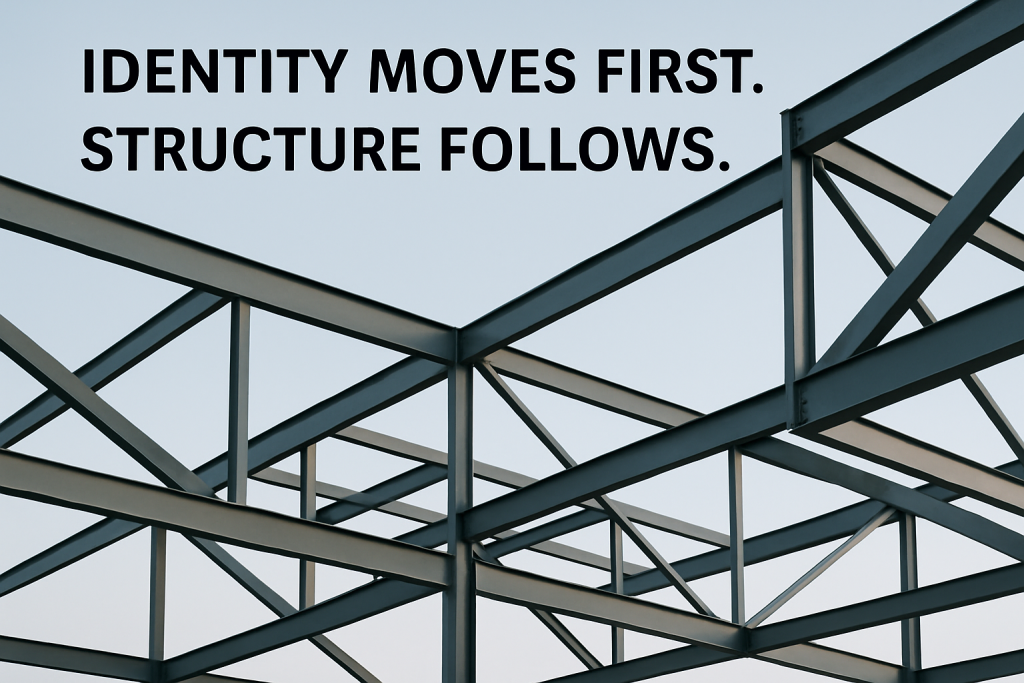
Most high-performing men in their forties and fifties do not find themselves stuck because they lack ambition, intelligence, or drive. They find themselves stuck because the structure of their life no longer matches the identity they have grown into.
From the outside, everything still looks solid. They are respected. They are relied upon. They deliver results that others admire. Their day is full, their calendar moves, and their work still matters.
But inside, something has shifted. Not dramatically, not in crisis form, but quietly and steadily. They feel a difference they cannot yet explain, and the harder they push through it, the more obvious it becomes that the issue is not effort. It is architecture.
Their identity has changed. Their structure has not.
Many midlife leaders fall into the same trap: the internal shift has already happened, but the external system is still running on an outdated operating model. They try to implement new priorities inside an old structure, and it simply cannot hold.
Once you see this pattern, everything about midlife reinvention starts to make sense.
Identity Moves First. Structure Rarely Follows.
Identity changes in stages. At first you notice little things. Your values sharpen. Your tolerance shifts. You find yourself wanting different types of challenges, different conversations, different ways of leading, or a different way of being recognized.
Over time, these small shifts accumulate. One day you realize you are no longer the person your current structure is designed for.
This is normal. This is expected. And this is where most men get stuck.
They assume that if identity changes, performance will naturally follow. But identity evolves internally, while structure only changes when you deliberately rebuild it.
Most men never do.
Instead, they continue running today’s expectations on yesterday’s framework.
Their calendar is still configured for who they were years ago.
Their boundaries were drawn around other people’s priorities instead of their own.
Their career incentives still reward old definitions of success.
Their daily rhythms reflect priorities that are no longer relevant.
The system defaults to the old self, even when the man has outgrown it.
This is not a motivational issue. It is a structural one.
And structural misalignment always produces drag.
The Corporate Pattern That Keeps Men Stuck
Research confirms what is often seen in practice.
Herminia Ibarra writes in Harvard Business Review that career reinvention often requires reshaping not just your choices, but the underlying assumptions and decision criteria that guided earlier career stages. When those criteria remain anchored in the past, people hesitate, delay decisions, and stay inside structures that no longer fit, even when their internal identity has moved on.
Source: https://hbr.org/2024/01/reinventing-your-career-when-its-not-just-about-you
A second study, Career Transitions in Midlife: Exploring Meaning-Making and Identity (2025), found that when people experience internal identity change but maintain old behavioral structures, motivation drops and ambiguity increases. Until the surrounding structure is rebuilt, people often describe the sensation of being “in between” who they were and who they are becoming.
Source: https://journals.kmanpub.com/index.php/psychnexus/article/download/3939/6747/19262
This is exactly why so many accomplished men feel a sense of drift in midlife.
Nothing is wrong, yet something is undeniably off.
They have not hit a wall. They have outgrown a design.
And because no one teaches leaders how to rebuild the structure around a new identity, they continue trying to execute inside a framework designed for a past chapter.
More effort will not fix the mismatch. Only structural redesign will.
How You Know Your Structure Is Outdated
Several indicators show up repeatedly among midlife leaders:
1. Your calendar reflects commitments from an earlier version of you.
2. Decision-making feels heavier than it should.
3. You have outgrown the role, though nothing is “wrong.”
4. You feel the pull toward something different, but the structure does not make space for exploration.
5. You continue performing well but feel disconnected from the impact.
These signals are not symptoms of burnout or disengagement. They are signs of structural expiration.
You have become someone your current framework was never built to support.
A Personal Moment of Realization
In my own career, this moment revealed itself long before I admitted it. On paper, everything worked. I had built a strong reputation, achieved results, and delivered consistently. But internally, I knew I was no longer the leader that structure was designed for.
The role had not changed. The expectations had not changed. But I had.
And the more I tried to push through the subtle misalignment, the clearer it became: no amount of discipline could compensate for a structure that no longer reflected who I had become.
Once I rebuilt the structure around the identity I wanted to lead from, everything else accelerated. Energy returned. Clarity sharpened. Decisions simplified.
The shift was not emotional. It was architectural.
Identity Is the Blueprint. Structure Is the Framing.
Think about a home renovation.
A blueprint shows what the space could be.
Framing determines what the space actually becomes.
Identity is the blueprint.
Structure is the framing.
You cannot expect a new experience if you never rebuild the framing.
This is where most midlife reinventions break down. Men refine the blueprint. They gain insight, clarity, perspective, even purpose. They know what they want more of and what they want less of.
But they never touch the framing. They rearrange the same room and hope it will feel different.
Real change begins when structure catches up to identity.
What a Modern Structure Actually Looks Like
1. Identity Anchors
These are principles, values, and leadership standards that define how you operate today, not years ago. They serve as the filter for decisions, commitments, and opportunities. Without clear identity anchors, structure defaults to old expectations.
2. Decision Rules
Clear decision rules spell out what earns a yes and what earns a no. Instead of responding out of habit or obligation, you make decisions using criteria that reflect who you are now. Updated rules force your calendar and commitments to align with your current identity instead of the one you left behind.
3. Energy Allocation Framework
Where energy goes, identity lives. If your structure allocates most of your energy to outdated obligations, you will continue living a past version of yourself. The right structure channels your best energy toward the work and leadership that matter in this chapter of your life.
4. Boundary Architecture
If decision rules define what you take on, boundaries define what you will no longer carry. Boundaries are not restrictive, they are protective. They safeguard the identity you are choosing to lead from. Modern structures include clear limits around time, access, and responsibility so you are not pulled back into roles or behaviors that no longer reflect you.
5. Leadership Environment
Structure is not only about time and tasks. It is also the environment in which you operate. The people, expectations, and culture around you either reinforce the identity you are stepping into or pull you back toward an older version of yourself. When the environment is misaligned, even strong structures struggle to hold.
How to Start Rebuilding Your Structure: Three Practical Moves
1. Rewrite one decision rule.
Pick a high-impact area, such as meetings, travel, or new initiatives. Create one rule that defines what earns a yes. Apply it consistently for 30 days and observe how your commitments shift.
2. Protect one block of identity-aligned time.
Designate a recurring block each week for work that reflects who you are becoming. Treat it as non-negotiable.
3. Name one structure that has expired.
Identify a pattern, expectation, or obligation built for a past version of you. Naming it removes its implicit authority.
Where to Go from Here
Reinvention does not begin with burning everything down. It begins with rebuilding the structure so your identity has a place to live.
Shedding the Script Workbook:
https://shedding.januslifecoaching.com
Article written by Brian Danco
Certified Coach and Business Leader

Brian Danco is a Certified Coach and Business Leader who discovered that conventional success, despite bringing titles and accolades, often leads to a profound sense of misalignment rather than fulfillment. After realizing his demanding executive career left no room for his personal purpose, he pivoted from simply “pushing through” to designing life with intention. He built a unique framework grounded in values and self-alignment, not just performance metrics. This strategy now powers Janus Life Coaching, where Brian partners with successful professional men feeling the restless urge for a new chapter. He specializes in helping them recalibrate, reconnect with their core values, and transform that restlessness into a confident, well-mapped plan for their next phase of leadership and life.